Common AI Myths Explained
Artificial intelligence has gone from a niche research topic to dinner table conversation in just a few years, and with that speed comes a lot of confusion. Movies, headlines, and social media posts have shaped public perception of AI just as much as the actual technology has, and the result is a strange mix of half-truths, outdated assumptions, and outright science fiction that people now treat as fact.
This guide walks through some of the most common misconceptions about AI floating around today, why they took hold in the first place, and what is actually going on underneath the hype.

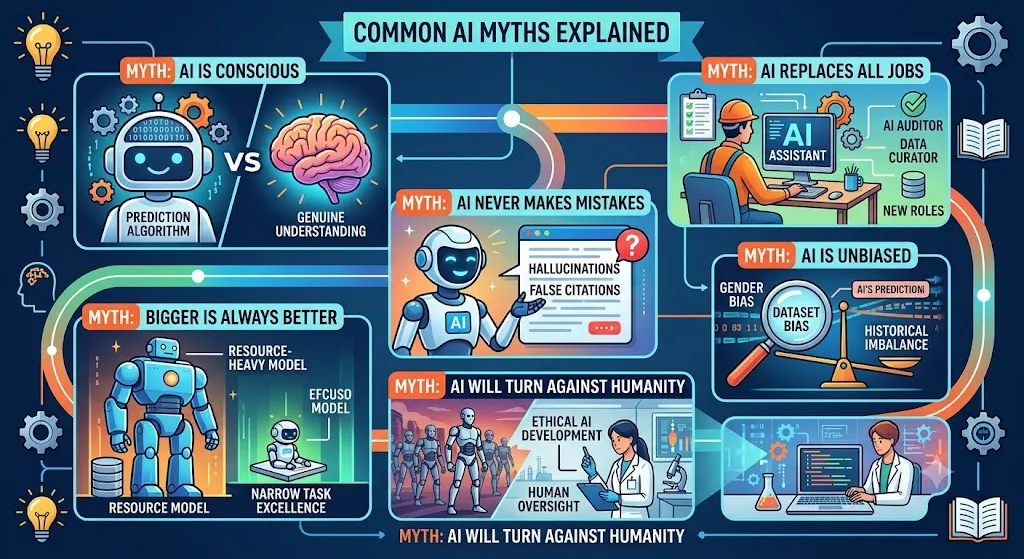
Myth 1: AI Is Conscious or “Thinking” Like a Human
This is probably the most persistent myth of all, largely because modern AI systems are genuinely good at sounding like they understand you. When a chatbot responds thoughtfully to a complex question, it is easy to assume something like understanding or awareness is happening behind the scenes.
In reality, the large language models behind today’s most popular AI tools work by predicting the most statistically likely next word based on patterns learned from enormous amounts of text. There is no inner experience, no desires, and no awareness of being a computer program answering questions. The output can feel remarkably human because it was trained on human writing, but fluency is not the same thing as consciousness. Researchers who study these systems closely are generally very careful to distinguish between an AI producing convincing language and an AI actually experiencing anything at all.
Myth 2: AI Is Going to Replace All Jobs Almost Overnight
Every wave of automation in history has come with predictions of mass unemployment, and AI has triggered an especially intense version of that fear. The reality on the ground has been messier and slower than the headlines suggest.
AI tools have absolutely changed how certain jobs get done, particularly ones involving repetitive writing, basic coding, customer support, and data entry. But full replacement of entire professions has generally not materialized the way early predictions suggested. What tends to happen instead is a shift in how work gets done. People who use AI tools well often become more productive within their existing roles, and new jobs centered on managing, auditing, and building on top of AI systems have emerged. That is not to say job disruption is not real or that it will not intensify, but the “AI takes every job by next year” version of the story has consistently proven too aggressive.
Myth 3: AI Is Always Objective and Unbiased
There is a comforting assumption that because AI is a machine, it must be neutral in a way humans are not. Unfortunately, that is backwards. AI systems learn from data that humans created, and that data reflects the biases, blind spots, and imbalances present in the real world and in the historical record.
If a hiring algorithm is trained mostly on resumes from a workforce that historically skewed toward one demographic, it can end up favoring similar candidates going forward, even without anyone intending that outcome. If an image generator is trained on a dataset where certain professions are overwhelmingly depicted by one gender, it may reproduce that pattern in its outputs. Bias in AI is a well documented and actively studied problem, not a fringe concern, and responsible development involves ongoing work to identify and reduce it rather than assuming it does not exist.
Myth 4: AI Never Makes Mistakes
Because AI tools can sound so confident, people often assume their output must be accurate. This is one of the more dangerous myths, especially as AI gets used for research, writing, and decision-making.
Language models can produce what is often called a hallucination, which is a confident-sounding statement that is simply false. This might mean inventing a fake citation, misremembering a historical date, or describing an event that never happened, all while sounding exactly as certain as when it gives a correct answer. The tone of confidence in an AI’s response has no reliable connection to how accurate that response actually is. Anyone using AI for anything important, from medical questions to legal research to basic facts, should treat its output as a draft or a starting point that needs to be checked, not a verified final answer.
Myth 5: Bigger AI Models Are Always Better
There has been a real trend of AI companies building progressively larger models, and for a while, bigger genuinely did mean better on most benchmarks. That created an assumption that scale is the only thing that matters in AI development.
The reality has grown more nuanced. Smaller, more efficiently trained models can now match or even outperform much larger ones on specific tasks, thanks to better training techniques, higher quality data, and smarter architecture choices. Model size is one factor among many, alongside training data quality, fine-tuning methods, and how well a model is suited to a specific use case. A massive general-purpose model is not automatically the best tool for every job, and a well-designed smaller model built for a narrow purpose can often outperform it on that specific task while running faster and cheaper.
Myth 6: AI Understands Context the Way People Do
AI tools can seem impressively context-aware, referencing something you said earlier in a conversation or picking up on a specific tone. This can create the impression that the system truly grasps the situation the way a person would.
What is actually happening is closer to sophisticated pattern matching across the text provided, rather than genuine comprehension of meaning, intent, or the real-world stakes behind a conversation. This is why AI systems can still miss sarcasm, misread emotionally sensitive situations, or give technically accurate but contextually inappropriate answers. They are working with the words in front of them, not a lived understanding of the world those words describe.
Myth 7: Only Giant Tech Companies Can Build Useful AI
A few years ago, this was closer to true, since building a capable AI model required enormous computing resources and specialized expertise that only a handful of companies had access to. That barrier has been dropping steadily.
Open-source models, cloud-based AI infrastructure, and pre-trained systems that developers can fine-tune for specific tasks have made it possible for smaller companies, independent developers, and even hobbyists to build genuinely useful AI applications without needing the budget of a major tech company. The playing field is far from perfectly level, since training the largest and most capable frontier models still requires massive resources, but the idea that only a few giant corporations can do anything meaningful with AI is increasingly out of date.
Myth 8: AI Will Inevitably Turn Against Humanity
Popular culture has given us decades of AI villains, from rogue robots to sentient systems that decide humans are the problem. This has shaped public imagination far more than the actual state of the technology.
Today’s AI systems do not have goals, desires, or the kind of autonomous agency depicted in science fiction. They do not “want” anything, including power or control. That said, dismissing all concerns about AI safety as pure fiction misses a more grounded set of real risks that researchers actually study, such as AI systems being used to spread misinformation, being deployed in ways that cause harm through carelessness rather than malice, or being given too much unsupervised authority over important decisions. The realistic risks tend to be less dramatic than a robot uprising and more about how thoughtfully and carefully AI gets deployed by the people building and using it.
Myth 9: You Can Just Trust AI Output Without Checking It
This myth is related to the hallucination problem but deserves its own mention because it shapes how people actually use these tools day to day. There is a growing habit of treating AI-generated answers as settled fact, especially when they are delivered in clear, confident, well-organized language.
The responsible approach looks more like using AI as a fast first draft or a starting point for research, then verifying anything important against a reliable source. This matters enormously in fields like medicine, law, and finance, where an AI’s confident but incorrect answer could lead to a costly or even dangerous mistake. Treating AI as a capable assistant that still needs human oversight tends to produce far better outcomes than treating it as an infallible authority.
Myth 10: AI Development Has Basically Plateaued (or the Opposite: It Will Solve Everything)
Public opinion on AI tends to swing between two extremes: either the technology has hit its ceiling and further progress will be minor, or it is on the verge of solving every major problem humanity faces. Neither extreme has held up well against how the field has actually developed.
Progress has been genuinely rapid in some areas, like natural language processing and image generation, while other areas, like reliable real-world reasoning and physical robotics, have moved more slowly and unevenly. AI is best understood as a powerful but still limited tool that continues to improve unevenly across different capabilities, rather than a technology that has stalled out or one that is about to fix everything on its own.
Why These Myths Matter
Misunderstanding AI is not just a harmless quirk of pop culture. Overestimating what AI can do leads people to trust its output uncritically in situations where a mistake carries real consequences. Underestimating it leads to complacency about genuine risks like bias, misinformation, and job disruption that deserve serious attention. And treating AI as either a magic solution or a movie villain distracts from the more grounded, practical conversations happening right now about how the technology should actually be built, regulated, and used responsibly.
The Bottom Line
AI is neither the conscious, all-knowing system some people imagine nor the harmless tool others assume it to be. It is a powerful, rapidly evolving set of technologies with real capabilities and real limitations, and the more accurately people understand both sides of that equation, the better equipped they will be to use it wisely, question it when needed, and separate genuine progress from hype.
1 thought on “Common AI Myths Explained”